Thursday, April 21, 2005

Day 2, Salar de Uyuni Tour, Bolivia

Diane: Last night, my Land-Rover-mates hit the hay fairly early. Another group could be heard laughing in the dining room. And another group was singing old Beatle songs accompanied by a guitar. I decided to join the singers. They welcomed me with rum and coke. A couple of the young men took turns playing the guitar. The young women would then join in singing, if they knew the song. The point of playing the guitar seemed to be to get the women to join in singing. Eventually all the women, except for me, headed off to bed singly and in pairs. At this point, the men showed off their guitar-playing prowess to one another. A couple of the guys were from Argentina and spoke Spanish as their first language. As the motivating force behind the evening, I slowly realized that they were vexed as to how to stay involved with the women who were already trying to sleep in the adjacent rooms. Finally they hit on the idea of serenading one of the rooms filled with women with the song "Hotel California" - a song that everyone would know. They invited me. And so for the first time ever, I participated in a night-time serenade.

The women, who weren't quite asleep, but were still a bit groggy, slowly realized what was going on, grabbed their cameras and started snapping flash photos through their darkened window. This added additional fuel to the fire of the serenaders. We were stars for the only-somewhat-dressed paparazzi. Of course, we were loud enough that I'm sure we woke the entire hostel.

Only upon subsequent reflection did I fully realize that these Argentinian men had probably spent the whole evening wooing these primarily European women. Between their rum-and-cokes, their guitar playing, sharing of cultures, friendly conversation, and serenading, their whole evening was a bit of a hunting game. I was entirely off the radar, I assume due to my age. However, I was delighted to be welcomed as a participant-observer. Tom and I had noticed at dinner that we were the oldest people at this hostel, housing some 30 or 40 people. This is always a welcome change from Sarasota, where we are many times the youngest people in a group of 30 or 40.

There are just so many stereotypes in this little story clamoring for my observation and attention that I don't know where to start. I am wimping out and, instead, I notice the date of this entry and realize that somewhere in the U.S., someone is probably celebrating Earth Day. Today, we celebrated this vast earth by visiting a remote corner and drawing in its serenity, tumultuousness, vibrant colors, and harsh contrasts all at the same time.

Nothing big and obvious lives on the Salar we drove over yesterday. Although today we were back on "regular" ground, as we rise in elevation (4500 meters above sea level), I find that nothing big and obvious lives here either. Unexpectedly, in an area entirely devoid of vegetation, Vicuna grazed contentedly. Our guide said they were living on micro-organisms in the soil. The llama and alpaca did not live at these elevations. We did pass a herd of domesticated llamas with their cute, little, red ear tassels. They were living in an impossibly small pen, and despite their reputed bad temperaments did not mind having their pictures taken.


Their owner, on the other hand, felt that she deserved to be compensated for our photo opportunism. I would have taken a picture of her demanding, scowling demeanor, but she probably would have wanted my weight in silver for such a golden opportunity.

The landscapes we passed through, passed from surreal to sculptural to inviting to barren. We passed a smoking volcano.


We stopped in canyon country for a chance to clamber around the rocks. Surrounded by red rock that reminded me a bit of the Garden of the Gods in Colorado Springs were what looked like small boulders covered in bright green moss. It turns out there was no boulder, just a plant, called yareta.


The views were stark.


All of the rocks had a covering much like eggs have a shell. These covering sheets of rock were eroding away to reveal the underlying base.


We ate lunch near a lake with a flock of wild flamingos who avoided us as best they could. The next lake we came to boasted another flock of wild flamingos also doing their best to avoid us.


Tom, the outlaw with his bandana wrapped around his face, fell asleep on the way to the Stone Tree.


When we arrived at the Laguna Colorada, our guide informed us that the red color of the lake was due to micro-organisms. There was also a lot of borax in area, enogh to climb on in fact.


The last bit of terrain today was very bare. Some of the mountains had a painting-like quality to them. In another area, large rocks were randomly plunked down in a vast emptiness. All majestic in their own way.


It is very cold tonight. There is neither running water, nor hot water in our very basic hostel, the only kind of accommodation available in the area. I told the kids to think of it as camping, but with the benefit of a building, a bed, and a warm meal at the end of the day. This didn't seem to help raise anybody's spirits, so I retired to my sleeping bag, while I was still warm. No singing tonight.

Wednesday, April 20, 2005

Day 1, Salar de Uyuni Tour, Bolivia

Diane: Yesterday, we finally got to ride a long distance train! Many of the South American passenger train services have been abandoned one by one over the years. In Bolivia, a once thriving industry now runs at just a fragment of its former capacity. According to our guide for the Salar de Uyuni tour, the train company used to employ 7000 employees in Uyuni alone. Now there are just a handful of employees. As it turns out, our guide is not a terrific source of information, except for the prices of various commodities, such as quinoa or salt, and our current elevation, so I take this with a grain of salt.


Although we sat on the sunny side of the train and kept the shades down for the most part, the large expanses of land were easily viewed through the large windows on the opposite side. The most extraordinary portion of the journey was riding through a large marsh/lake. It seems an unlikely spot for railroad tracks.


Today we started our tour of the Salar de Uyuni, salar meaning salt flat and Uyuni being the name of the nearest town. It was a fantastic spectacle - a white lake of salt, up to 120 meters deep at its deepest. Small portions of the salar were still underwater following the rainy season, meager as it was.


We traveled by Toyota LandCruiser, 6 passengers to each vehicle.


We stopped in a small town where they refine salt and make salt sculptures to sell to tourists. Salt certainly left its mark.


The walls of the store were made entirely of salt bricks. Calliope took a taste just to be sure.


The most popular construction method involved the use of calcified rock for the foundation, adobe bricks for the walls, and grass (paja) roofs.


Our next stop was to examine the salt mining methods used on the Salar. As the water in the Salar dries up after the rainy season, locals create large mounds of salt. These mounds dry in the sun for about a month, and then are loaded into the back of a pickup and for the most part, carted off to be refined for personal use.


Still traveling on the Salar, our next stop was the Salt Hotel. The building is made of salt; the chairs are made of salt; even the beds are made of salt.


This building is no longer used as a hotel, so they call it a museum now.

We ate lunch at Fish Island, so called, because as you approach it from a distance and from a certain angle and at a certain time of year, it looks like a fish. We evidently didn't hit it quite right. It is covered with wonderfully huge cacti and craggy volcanic rock.


We continued, carefully skirting an area of the Salar in which cars would sink if they weren't careful, even taking a road where necessary.


Our hostel for the evening was located in the small town of Chuvica. The crusty dirt, salt, and plant formations along the edge of the Salar were captivating.


Sunday, April 17, 2005

Musings, La Paz, Bolivia

Diane: Although I had anticipated only a day or two of rest in La Paz to split up a 20 hour bus/train ride, we ended up staying 6 days. Everybody but me was strongly affected by the altitude. The airport in La Paz is at around 4000 meters above sea level. Most of the city is built on a downward slope from about 4000 to about 3500 meters above sea level. Although Cusco is at 3300 meters and we didn't suffer there, La Paz was a different kettle of fish. We found an apartment on the tenth floor with lots of light and a great view of the city. Julia, the amiable owner is a single woman and she rents out 2 small bedrooms - one with two twin beds and one with a full-sized bed. With my usual flair for timing, it was as if she was waiting for us, since neither room was occupied. The alternative accommodations in the city center were overpriced, smelled terrible, had tremendous street noise, or were just plain decrepit, so this was a great find!

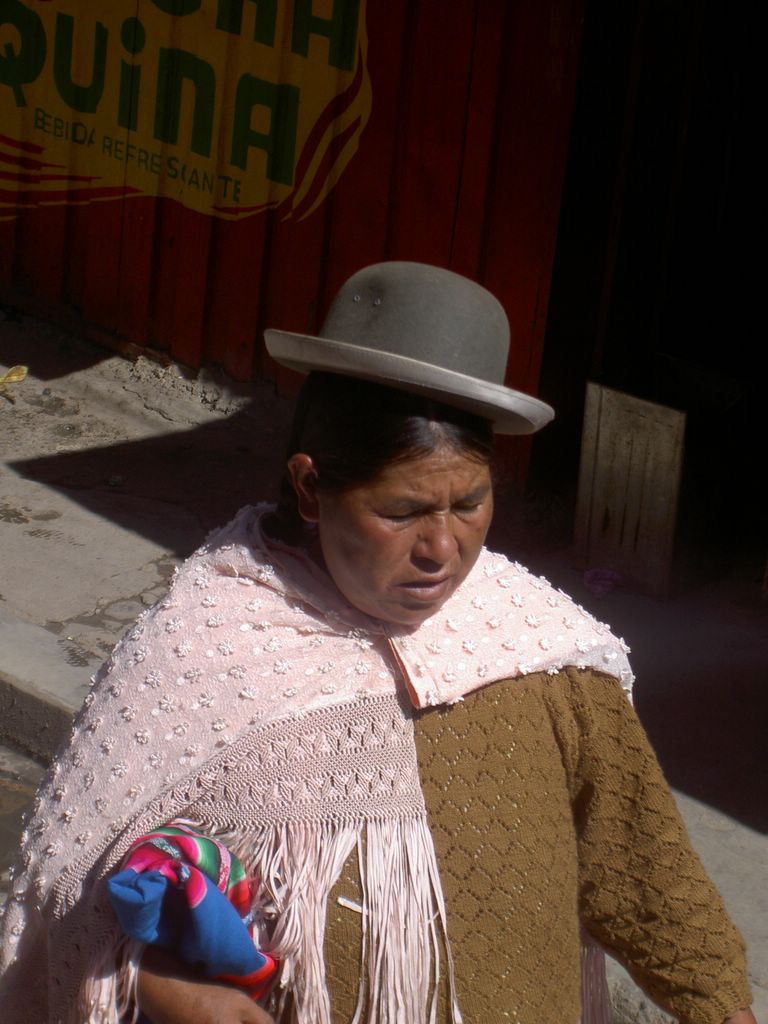
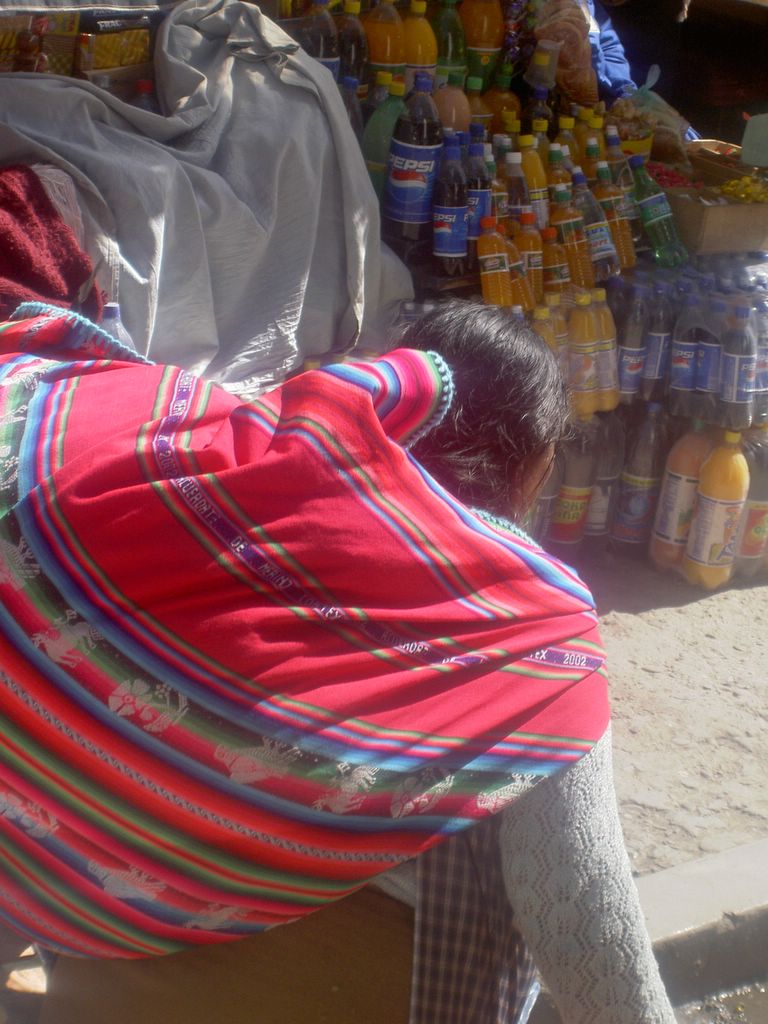
Although a big, dirty city with lots of poverty, I am very comfortable in La Paz. There are several vegetarian restaurants to choose from within a short radius of our apartment. Even better, a lot of the street food is vegetarian. There are lots of street vendors who make carrot juice or orange juice right on the spot - and not the watery, gloppy juice I learned to avoid in most of Peru. There is a lot of hustle and bustle, but most of it is not directed at foreigners, so it feels very authentic after a couple of weeks in the Sacred Valley of Peru, whose economic base is tourism. As in most cities we have visited, many of the women continue to wear their traditional clothing. But here, it feels like a much larger percentage continues their traditions. At this altitude, the temperature is generally cold year round. Consequently, the women dress in layers, so to my eyes many of them are an unexpected Christmas-tree shape when all is said and done. There embroidered blouses and shawls shimmer a bit in the daylight. Many women street-vendors wear colorful blue and white checked aprons. None of these women used backpacks; they used the colorful blankets of the region to cart their loads. The ubiquitous bowler hats complete their wonderful outfits. I'm still hoping for some good pictures of this to show up on my computer.


Since we stayed so long, I had an opportunity to tour some of the city's more interesting museums. The Coca Museum chronicles the long and somewhat convoluted history of the use of coca leaves in Bolivia. I am aware that the United States has been heavily involved in attempting to eradicate the drug economies and fields of many South American countries, but there was a lot more to it. For example, during colonial times, there was a double standard. Spain made the use of coca illegal in Spain, but legalized it in Bolivia, with the intent of increasing the hours worked by the indigenous miners. To this day, miners live and work in substandard conditions.

Calliope and I went to a street fair on the Prado today. Half of it looked like street fairs at home, with public safety displays, games and races for kids, dancing groups, people hamming it up in costumes, and jugglers.


But, the other half was almost entirely political. Huge illustrated panels explained the plight of miners. And I wasn't the only one reading them. Each block held a new petition to sign. Several important indigenous rights activists are being held indefinitely in detention in La Paz without trial. There were bands with anti-free-trade songs. As I understand it, Bolivia is the poorest, most exploited South American country. There are strikes here regularly that affect everything from the availability of food to the passage of traffic on primary roads. With such a highly activist population, I do not understand why some sort of justice has been so slow to get here. There must be so many unpublicized tragedies here.

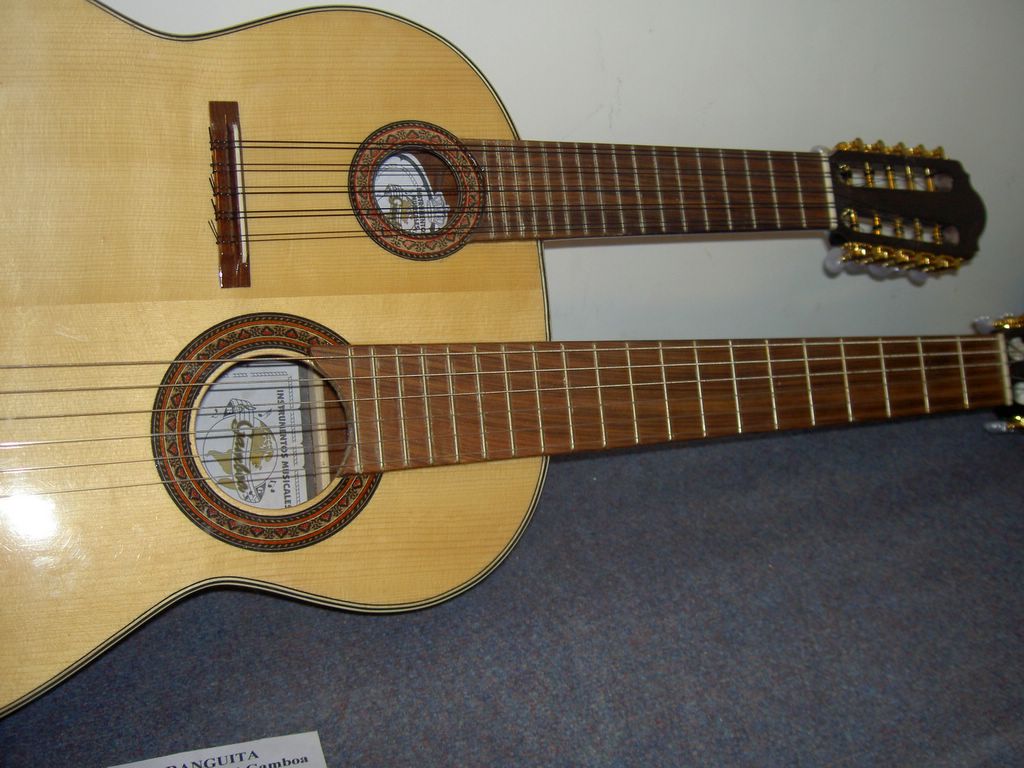
I also had time to visit the Museum of Musical Instruments. Not many cultures could support an entire museum devoted to musical instruments, but Bolivia has a strong and vibrant musical history. The guitar and its many variants are standard fare in Bolivia as well as the rest of South America. Young men grow up learning to play the guitar in order to serenade the women of their dreams. The museum displayed guitars made from animal hides and shells and in many shapes and sizes.


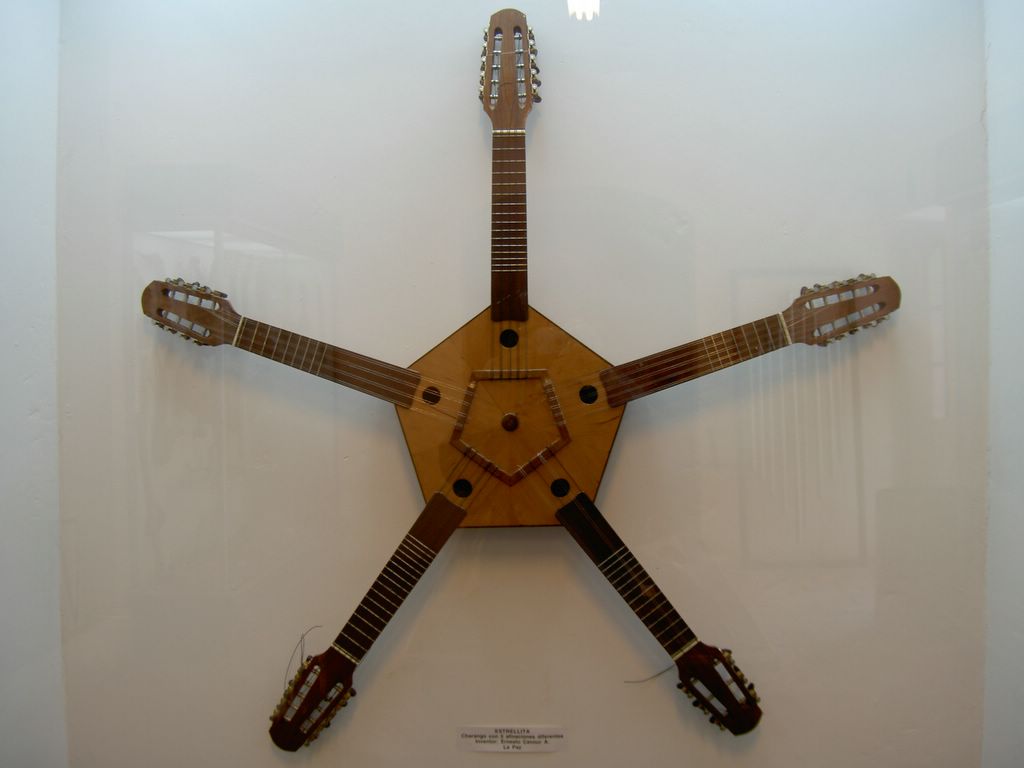
There was one room dedicated to musical inventions. I'm not sure how you'd play a two necked guitar, but the display certainly got me thinking.


How about a 5 necked stringed instrument?


There are many traditional percussion instruments as well. Many shaker-type instruments are made from various plant products. But some are made from metal.


Yet others are made of coins!


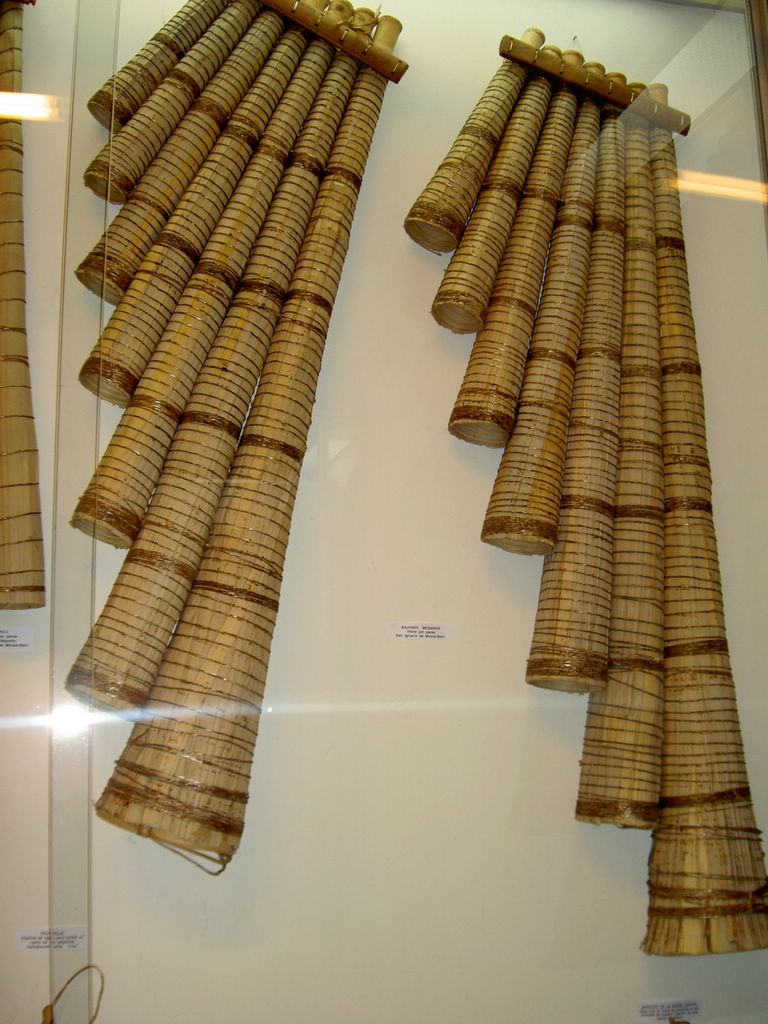
As in Peru, wind instruments play a large role in the musical sounds of Bolivia.


Evidently, as in Peru, no Bolivian museum is complete without a mummy.


Although the mummy was an antique, many of the instruments on display were made recently. The art of making musical instruments is alive and kicking in Bolivia.

A couple of days ago, I lured TM out of bed to join me in a short expedition in search of the perfect acne cure. I had seen the impressive witch's market in Chiclayo, but the one in La Paz was larger with a wider selection, so I figured our chances for success were pretty good. There were a lot of love potions,


llama-fetuses,


thank-you offerings,


and cures for the most incurable of conditions.


Really, they seemed to have just about everything, except acne cures. And then it hit me - the indigenous people here don't get acne. So of course they wouldn't be selling acne cures.